CHH Featured Flashback Header

The content of this recap is also available in the 2020s page of our U.S. College Hockey History section of this site.

The final game played at the historic Matthews Arena in Boston occurred during the 2025-26 season. The original arena opened April 25, 1910, when the Harvard freshmen played Newton High School. Later that night, Harvard became the first-ever varsity team to take the ice at the arena when it played the Crescent Hockey Club. The first-ever intercollegiate hockey game to be played at the arena took place the following season when Harvard and MIT met December 18, 1910. A catastrophic fire destroyed the original building in December 1918. The second iteration of the arena opened a little more than three years later when MIT hosted King’s College from north of the border. The Canadian team won that January 7, 1921, game 4-3. Harvard, MIT, Boston College, Boston University and numerous professional teams called the rink home over the years. Northeastern played its first hockey game there on January 17, 1930, and ultimately became the main tenant of the arena in October 1979. The university renamed it Northeastern Arena and ultimately Matthews Arena. On December 13, 2025, the Northeastern men hosted Boston University in the last hockey game played in the historic rink. The Terriers won 4-3, which is fitting since the first hockey game played between these programs was at the same rink in February 1931 when the Terriers defeated the Huskies by the exact same score.

Boston Arena in black and white from the early 1920s.
A photo of Boston Arena from the early 1920s.

Two hockey programs separated by 3,000 miles celebrated 100 years of hockey during the season: Alaska and St. Lawrence. Two Division I programs also debuted new hockey rinks. The Lee & Penny Anderson Arena opened on the St. Thomas campus when the women’s team hosted Providence. The men’s teams from the same schools played the second game of a debut doubleheader. In Schenectady, New York, the M&T Bank Center opened its gates September 26, 2025, when the Union women played Franklin Pierce. The Garnet Chargers previously played at Messa Rink; an arena that hosted its first Union hockey game in 1975. In the NCHC, the Miami RedHawks snapped its 26-game winless streak with a 6-4 win over Ferris State in the season opener. The team kept rolling and won its first six games of the season with the last two coming in overtime. It was the first back-to-back overtime wins in program history. Within the Big Ten, the Gopher men snapped an 11-game shootout losing streak after defeating Boston College. Going into the shootout, the team had missed its previous 28 shootout attempts, as impossible as that may seem. Coincidentally, the Gophers first-ever regular season shootout was against Boston College nearly 12 years beforehand at the same rink.

Unfortunately, two Division I programs closed their doors at the end of the season. Mercyhurst debuted its hockey program in 1987 within Division III and elevated to Division II in 1992. The Mercyhurst men played their last game March 7, 2026, against Bentley, which coincidentally was the first conference opponent the Lakers faced in 1999 after joining Division I. Note that the Mercyhurst women’s hockey team will continue operations. The Simon Fraser Red Leafs of Burnaby, British Columbia decided to discontinue the school’s Non-Conference Team at the conclusion of the season. The Non-Conference Team had operated as an independent program for three seasons with a schedule predominantly made up of U.S. Division I teams. The Red Leafs played 20 NCAA Division I and three Division III programs throughout its tenure. The first program win over an NCAA Division I team came against Alaska Anchorage in 2022. A notable 2024 game for Simon Fraser saw the Red Leafs tie the second-ranked team in the U.S. at the time, Boston University. The last game the team ever played was in Ann Arbor, which happened to be the first time the program had played the Wolverines. Note that the Simon Fraser BCIHL team will continue operations.

Changes were made to a couple of postseason tournaments in the Division I men’s world. Big Ten Hockey reduced its tournament to a two-and-a-half week single elimination tournament instead of a three-weekend tournament where the first round was a best-of-three series. On the other hand, the NCHC shifted to a setup that mirrored the previous Big Ten format. In doing so, the NCHC moved to an entirely on-campus tournament for the first time. Excluding 2020 and 2021 due to COVID, the final weekend of the tournament had previously been held in Minneapolis or Saint Paul. This change saw the conference host a three-weekend tournament for the first time, with the first weekend being a best-of-three series. The tournament trophy was also branded the National Cup, a name change that mirrored the new secondary branding of the NCHC. Denver ended up hosting UMD in its first single-elimination conference tournament title game on home ice since 1970. The Pioneers won in double overtime, marking it the second double overtime championship game in a row for Denver and the NCHC. This was the first time in the Division I men’s hockey era where a conference’s tournament title game went to double overtime in back-to-back seasons.

In the CCHA, Minnesota State and St. Thomas squared off in the tournament championship game for the second season in a row. This time a berth to the NCAA tournament was truly on the line. The Mavericks were victorious again. This marked the last CCHA conference game played by the Tommies as they are moving to the NCHC for the 2026-27 season. It also marked the fourth Mason Cup for the Mavericks in the past five seasons.

Looking east, the ECAC men’s conference title game was an Ivy League affair between Dartmouth and Princeton. The all-time hockey series between the two schools started nearly 120 years beforehand on January 9, 1907. Dartmouth won the 2026 title game and earned a trip to the national tournament. It was the first-ever conference tournament championship for the Big Green. Note that Dartmouth defeated Harvard in a one-off playoff game in 1949 for the Pentagonal League title, but that was not part of a tournament. The 23 wins this season also set a team record for a program that dates back to 1905. The Quinnipiac Bobcats won the ECAC men’s regular season title for the sixth time. And for the sixth year in a row, the Bobcats lost in the conference tournament as the top seed. Within Hockey East, Merrimack became the lowest seed (#8) to advance to the Hockey East championship game, let alone win it. This was the first Hockey East tournament title for the Warriors. Within Atlantic Hockey America, the Bentley Falcons won the men’s regular season and tournament championships. It was the Falcons first Division I regular season title. The Falcons last won a regular season title back in 1997 when the program participated in Division III.

For the first time in the Division I men’s hockey era, an end-of-season tournament was held for the independent programs. Five teams took part in the inaugural United Collegiate Hockey Cup hosted by Lindenwood in Maryland Heights, Missouri. Alaska received the lone bye and went on to become the first team to win the tournament after defeating the host Lions in overtime of the championship game.

The NCAA Division I men’s tournament included no Beanpot teams for the first time since 1981. The men’s Frozen Four was held in Las Vegas for the first time. The four teams in Las Vegas (Denver, Michigan, North Dakota, Wisconsin) just happened to be the top four teams with the most NCAA Division I men’s titles with a combined 33 championship trophies amongst them. And in addition to that, for the first time in NCAA history all four starting goalies were freshmen. Decades earlier, all four teams were WCHA division foes between 1969 and 1981. One of the semifinal games pitted Denver against Michigan. The Pioneers were victorious in overtime to advance to the championship game. This marked the fifth NCAA semifinal game in a row for the Pioneers where the outcome was decided in overtime – all since 2019. In the final game of the season, Denver came from behind to defeat Wisconsin to increase its NCAA lead with an 11th championship trophy. This marked the third title for the Pioneers in the last five seasons. It also meant that another NCHC team was crowned the champion. It’s the eighth championship for the NCHC in the past 10 seasons; the most dominant conference run in men’s hockey since the WCHA won 10 of 11 from 1973 to 1983.

Embed from Getty Images

Within Division I women’s hockey, a new program debuted in Delaware. The Fightin’ Blue Hens became the first NCAA hockey team to be based in Delaware after debuting within Atlantic Hockey America. Within the ECAC, Princeton and Yale shared the regular season crown. This was the first regular season title for Princeton. The semifinals and championship game of the ECAC women’s tournament was held off-campus for the first time. The games took place at Herb Brooks Arena in Lake Placid, where the three-seed Quinnipiac defeated top-seed Yale.

The women’s Frozen Four was held at Pegula Ice Arena on the Penn State campus. The Nittany Lions had a hometown advantage after the team made it to the Frozen Four for the first time. The resulting Penn State versus Wisconsin semifinal game set an arena and Frozen Four attendance record with 5,176 fans. Wisconsin ended up winning in overtime to set the stage for yet another Wisconsin and Ohio State championship game; the fourth in a row. The Badgers won 3-2 to add to its NCAA-leading number of women’s NC championships with nine. This was also the 23rd WCHA team to win a women’s hockey championship. Wisconsin has won the championship in five of the past seven seasons. The past six championship games were all very competitive with all six being decided by one goal.

Embed from Getty Images

Caroline Harvey was awarded the Patty Kazmaier Award – the second Badger to earn it in a row and seventh overall. The Badgers broke a tie with Harvard for most recipients of the award that’s handed out to the top female college hockey player in the United States. Max Plante took home the Hobey Baker Award; the seventh time a UMD Bulldog was awarded the trophy. Scott Perunavich was the last Bulldog to do so in 2020. High school hockey fact: Hermantown High School in Minnesota (enrollment 612) is the first-ever high school to produce multiple Hobey Baker winners (Drew LeBlanc in 2013 for St. Cloud State and now Max Plante).

Within Division III men’s hockey, the Hamilton Continentals (Kirkland, New York) defeated Hobart 2-1 in overtime. It was the first hockey championship for a program that’s been around since 1918. The Continentals also prevented Hobart from celebrating a four-peat in the process. It was the second Division III men’s title game in a row that ended 2-1 in overtime and fifth overtime championship game in the past seven seasons.

The Wisconsin-River Falls Falcons shut out Nazareth (Rochester, New York) 4-0 to secure a three-peat in Division III women’s hockey. This is the first three-peat since Plattsburgh won four in a row from 2014 to 2017. It was the first championship game for runner-up Nazareth.

Midland University (Fremont, Nebraska) won its first ACHA Division I women’s hockey championship after defeating top-seed Liberty. The game went to triple overtime before the Warriors won 4-3. Midland won its final three tournament games in overtime.

Current and former college hockey stars were front and center in midseason tournaments in 2026. For the first time ever, the NCAA sent a select team of current college players to the Spengler Cup to represent the NCAA. The hockey tournament based in Switzerland has a history that dates back to 1923. It features club and national teams from Europe and North America. The Minnesota Gophers previously participated in 1981 and North Dakota in 1982. The schools sent their full teams to play in the exhibition mid-season tournament. This team in 2025 was essentially an NCAA all-star team – a first of its kind for the Spengler Cup. The team lost its first game to Team Canada but later defeated HC Davos and then Canada in a rematch. The U.S. Collegiate Selects surprised the European crowd and hockey community by advancing to the championship game on New Year’s Eve. However, the team fell short as HC Davos won its 17th title after a 6-3 victory. Seventeen college programs were represented on the roster with Penn State leading the way with five players. It was later announced that a select team would represent the NCAA in at least the next two Spengler Cups.

The 2025 U.S. Collegiate Selects team that competed in the Spengler Cup.

The 2026 Olympics were held in Milan Cortina, Italy. Team USA and Canada met in the women’s gold medal game for the fifth Olympics in a row. The U.S. had blanked Canada in preliminary play just nine days before. All 46 players in the women’s gold medal game had ties to NCAA hockey. Wisconsin led the way with 11 players, followed by seven from Ohio State and five from Minnesota. Overall, 16 college programs were represented that evening. The final game was decided in overtime when Megan Keller (from Boston College) scored the golden goal. Team USA scored a total of 33 goals throughout the tournament and only gave up two.

Embed from Getty Images

It was déjà vu on the men’s side as Team USA and Canada met in the gold medal game as well. It was the sixth gold medal game between the two countries and first since 2010 when Canada won in overtime in Vancouver. In poetic fashion, this 2026 game was decided in overtime as well. The United States won 2-1 to secure the men’s hockey gold medal for the third time in U.S. history. Of the 25 players on the U.S. roster, 19 played college hockey. Five played for Boston University, four for Michigan, two for both Boston College and North Dakota, and one each for Colorado College, Connecticut, Maine, Massachusetts Lowell, Minnesota, and Omaha.

Embed from Getty Images

CHH Featured Flashback Header

The College of St. Thomas in Saint Paul, Minnesota, announced in 1920 that a new varsity sport was going to debut that winter: ice hockey. The sport itself wasn’t new to the school. In fact, elevating the sport to varsity status was a long time coming as players from the school had originally donned the purple and gray for games on Lake Mennith sixteen years prior in 1904. The swampy lake was on campus until 1909 when the city built a sewer line for Summit Avenue that eventually drained the water. It officially dried up in 1911.

The first varsity captain for St. Thomas was George Conroy, a left wing who previously played hockey as a junior member of the Saint Paul Athletic Club. Bill Houle was the leading scorer, having netted 34 goals by season’s end for St. Thomas. The Cadets, as they were known as at the time, played an 11-game schedule in the inaugural season. The Minnesota Intercollegiate Athletic Conference (MIAC) was in its infancy after forming earlier that year in 1920. St. Thomas was one of three teams from the conference to offer varsity hockey during the 1920-21 season, along with Macalester and Hamline. St. Thomas stated at the time that the MIAC teams wouldn’t have had a three-team hockey conference that first year if it wasn’t for Howard Dudley. The school said it was his initiative that drove the formation of the league. He was asked to become manager of the Cadets in that first season. He was a current student at the college and was the team captain of both the St. Thomas football and baseball teams.

The Cadets played an initial three-game conference schedule with the remaining games counting as practice, non-conference, or exhibition depending on the terminology used in the description of the games. The team was undefeated in league play after taking down Macalester 9-1 and then Hamline twice by scores of 3-1 and 5-1. The conference games were played at Lexington Rink in Saint Paul as all three teams were located within that city. The conference was often referred to as the Triangular League – not to be confused with the East Coast’s version of a league of the same name.

The most lopsided victory during the season was a 21-1 drubbing of the Fort Snelling team. The Cadets only allowed eight goals throughout the entire 11-game season. The team would go on to finish with an 10-1 overall record that included an undefeated 3-0 conference season. St. Thomas claimed the first hockey title of the MIAC teams. An interesting aspect of that first season was the last game’s opponent. A team from the University of Minnesota represented the Gophers but hockey had yet to be recognized as a varsity sport at the school – something that would happen the following season. Because of this and the fact that the game occurred after the conference championship was secured, St. Thomas referred to it as an exhibition game. The Gophers won 3-1. While the Cadets admitted the Gophers fielded a strong team, they also pointed out that the outdoor rink conditions were very poor. Due to all of the above, St. Thomas crowned themselves the college hockey champions of the state of Minnesota in 1921. Within the featured photo, the hockey stick in the foreground reads “Champions 1921” in white lettering on the black tape.

Predictably, the St. Thomas hockey program has evolved throughout the years. Outside of hockey, the school changed its name from a college to a university and adopted the Tommies nickname in the late 1920s. The team was a member of the MIAC until the university elevated all of its sports to Division I in 2021. The school launched a women’s varsity hockey team in 1998. And most recently, the Tommies are set to open a brand new on-campus rink on Friday, October 24, 2025. The women’s team will play the first game at the Lee & Penny Anderson Arena when they host Providence. The men will play the same school later that evening. This will mark the first-ever hockey games between St. Thomas and Providence. St. Thomas hockey, and the sport itself, has evolved a lot since the early 1900s. But one thing has come full circle: hockey is returning to campus, and the new rink will be only 2,000 feet away from the very first puck drop that took place on Lake Mennith 121 years ago.

Photo Credit: 1920-21 St. Thomas hockey team photo from the 1921 St. Thomas Kaydet Yearbook.

Embed from Getty Images
CHH Featured Flashback Header

The content of this recap is also available in the 2020s page of our U.S. College Hockey History section of this site.

The four-year streak of a new NCAA men’s hockey team joining Division I was snapped this year. However, one conference expanded. Arizona State found a home in the NCHC during the 2024-25 season after spending nine seasons as a DI independent. The program won its first Division I conference game when the Sun Devils beat Omaha at home 3-2 on November 16, 2024. Later that month, the Sun Devils defeated Denver 3-2 to earn its first win over a top-ranked team in the nation. This win snapped Denver’s 21-game unbeaten streak in the process. Arizona State would later win its first conference playoff game and series after sweeping UMD in the opening round at home. The Sun Devils participated in the Frozen Faceoff and were defeated by Denver 4-2. The Pioneers, in turn, lost the following night when Western Michigan took down Denver in double overtime. Western Michigan won its first Frozen Faceoff title in the final NCHC championship game to take place in Saint Paul. Beginning next season, the entire NCHC playoffs will be played on campus.

The NCHC announced in the off-season that it would add another new member in St. Thomas in 2026-27. With the news of the Tommies’ future exit from its current conference, the CCHA, in turn, announced Augustana would become a full member in 2024-25; a year earlier than scheduled. Due to an unbalanced conference schedule for Augustana compared to the rest of the CCHA, the conference switched to points percentage this season to determine the standings. The Vikings finished second to Minnesota State in the standings. A unique situation occurred during the 2025 CCHA Mason Cup playoffs. When St. Thomas defeated Bowling Green in the semifinals, it ensured that the winner of the other semifinal between Minnesota State and Bemidji State would receive an automatic bid to the NCAA tournament. This was because St. Thomas was not eligible for the tournament due to a mandatory four-year waiting period after transitioning from Division III to Division I. In a semifinal with unexpectedly high postseason ramifications, the Mavericks downed the Beavers 4-0 to earn the bid. The Mavericks put an exclamation point on the tournament the following week with a 4-2 win in the championship game, thus regaining the Mason Cup for the third time in four years.

The Lindenwood men’s hockey team defeated the Wisconsin Badgers in Madison October 11, 2024. It was the first program win over a top ten ranked opponent as well as its first win over a Big Ten team. Two weeks later in Indiana, LIU defeated Notre Dame for the program’s first road win over a ranked opponent. LIU finished the season with a record of 20-12-2; the first time the program hit the 20-win plateau in a season.

Denver hosted UNLV for a holiday-season exhibition game on December 28, 2024. UNLV, an ACHA Division I hockey program, shocked the hockey world by defeating the Pioneers in a shootout 7-6. Granted, Denver was without head coach, David Carle, and star defenseman, Zeev Buium, but this was historic. It’s safe to say this was the first time an ACHA (club) team defeated the defending Division I men’s hockey team who also owns the record for most NCAA Division I hockey titles. In April, the Skatin’ Rebels capped its historic season with the school’s first-ever ACHA Division I national hockey championship.

Two Division I men’s conference championship games went to double overtime. This was just the second time this ever happened in the same season; the only other occurrence took place in 2017. In addition to the aforementioned NCHC title game when Western Michigan outlasted Denver, the Michigan State Spartans defeated Ohio State in double overtime by a score of 4-3 to earn its second Big Ten tournament title in a row. Elsewhere, Bentley won the Atlantic Hockey America tournament. The Falcons hoisted the Riley Trophy for the first time, granting the program its first-ever berth in the NCAA hockey tournament. Within Hockey East, Maine won its first Hockey East tournament since 2004 after defeating UConn in the title game. UConn, however, earned an at-large bid to the NCAA tournament; its first time ever participating in the national tournament. Within the ECAC, Quinnipiac won the regular season title for the fifth season in a row. However, the Bobcats lost in the semifinals of the conference tournament. Quinnipiac has not won any of the five conference tournaments throughout this five-peat run.

During the 2025 NCAA Division I men’s tournament, Denver and Boston College met in the Manchester Regional Final for a rematch of the 2024 title game. Since 1949, there have been seven instances of a title game rematch happening in the following season’s tournament. In all seven instances, the runner up from the season before avenged the loss. History did not repeat itself in 2025 as Denver beat Boston College 3-1 to earn a trip back to the Frozen Four.

The men’s Frozen Four took place in St. Louis for the first time since 2007. Of the four teams that made it, two are considered college hockey blue bloods in Denver and Boston University and two are first-time participants in Western Michigan and Penn State. Western Michigan defeated Denver in double overtime in the early semifinal. It was the second time the Broncos defeated the Pioneers in double overtime in 21 days. Also, the only other time these two teams met in the NCAA tournament, that too ended in double overtime. But Denver was on the winning side of that 2011 first round contest. The late semifinal game saw Boston University defeat Penn State; thus, ending the Cinderella run for the 13th overall seed. Western Michigan defeated Boston University two days later and claimed the program’s first NCAA hockey title. It was the third time in five years that a first-time winner was crowned for the Division I men. The Broncos are also the first champion to win two double overtime games in the NCAA tournament en route to a title. Western Michigan is the first men’s team to pull off the trophy trifecta (conference regular season title, conference tournament title, NCAA title) since Union in 2014. A Michigan-based team has won all three Frozen Fours hosted in the city of St. Louis (Western Michigan in 2025, Michigan State in 2007, and Michigan Tech in 1975).

Embed from Getty Images

The women’s Frozen Four was held at Ridder Arena. It was the seventh time it took place on the University of Minnesota campus. Two WCHA powerhouses met in the championship game yet again. In fact, it was the third year in a row that Ohio State and Wisconsin faced off for the championship trophy; the first time that has ever happened in the NC women’s hockey tournament. Wisconsin won two years ago, and Ohio State won the previous season. The two previous title games were decided by one goal and this year wasn’t any different. Wisconsin tied the game on a Kirsten Simms penalty shot with just 19 seconds left in regulation. The Badgers then won the game 4-3 in overtime on another goal by Simms. It was the fourth championship trophy for the Badgers in six seasons. Wisconsin has now won the hockey championship in the last four odd-numbered years. The Badgers increased their lead in the overall title count by adding this eighth trophy. This was also the 22nd women’s hockey championship for the WCHA.

Embed from Getty Images

In Division III men’s hockey, Hobart completed a three-peat after defeating Utica 2-1 in overtime during the championship game of the 40th NCAA hockey tournament for Division III. The Statesmen have defeated three different teams in the three consecutive championship games. The last time there was a three-peat in Division III men’s hockey, Middlebury (Vermont) won three in a row from 2004 to 2006.

The longest women’s hockey game in Division III history took place during the MIAC tournament. Augsburg (Minnesota) defeated Saint Mary’s University of Minnesota by a score of 3-2 when Aunna Schulte scored eight minutes and six seconds into the fourth overtime. The field for the NCAA Division III women’s tournament was expanded from 11 to 12 teams this year. For the second year in a row the semifinals and title game were held in River Falls, Wisconsin. It was held there in 2024 because Wisconsin-River Falls was the highest remaining seed. However, it was chosen as a predetermined site prior to this 2024-25 season. But as luck would have it, Wisconsin-River Falls made another tournament run and ended up back in the championship game at home. The Falcons defeated Amherst 3-1 to claim back-to-back titles.

Four 2025 NCAA hockey champions: Wisconsin, Western Michigan, Wisconsin-River Falls, and Hobart.

For more than five decades, if a hockey prospect played in one of the Major Junior leagues in Canada or even signed a contract with one of the teams, it rendered a player automatically ineligible from NCAA hockey. In fact, NCAA hockey did not accept players who had even played in a game against a professional player. However, this changed November 7, 2024, when a vote was passed that allowed NCAA Division I teams to recruit prospects who participated in Major Junior hockey or professional teams. The caveat was that the players must never have received payments more than the actual and necessary expenses as part of their participation on the team. Players who accepted additional expenses or gifts, or signed NHL contracts are still deemed ineligible in the eyes of the NCAA. It was determined that eligible players would be able to begin play within the 2025-26 season. Division III was excluded from this ruling. Braxton Whitehead was the first Canadian Hockey League player to commit to an NCAA team. Whitehead, an alternate captain for the Regina Pats of the WHL, verbally committed to Arizona State on September 13, 2024. He did so due to a class action suit filed against the NCAA to allow CHL players to be deemed eligible. The NCAA voted less than two months later to allow it. The fact that NCAA players currently earn scholarships and money from name, image, and likeness (NIL) helped fuel this change.

This is the next installment in our On Location series where we live tweet a college game (or games) that we attend in person and then later post an article here on the site. This is a special instance in that it’s in essence a combination of our On Location and Relevant Rewind series because the game took place November 19, 2022, and we’re just pulling it out of the vault and posting it now.

The St. Thomas men’s hockey program hosted Michigan Tech for a weekend CCHA series in November 2022. Heading into the weekend, the Tommies held an overall record of 2-10 while the Huskies were sitting at 6-3-2. At the time, Michigan Tech led the all-time series 12-4-2; one that dated back to 1922. The majority of these games took place before St. Thomas joined Division I prior to the 2021-22 season.

The St. Thomas Ice Arena in Mendota Heights, Minnesota, is the current home to both the men’s and women’s hockey teams at St. Thomas. It’s also home ice for St. Thomas Academy boys hockey. The Lee and Penny Anderson Arena will open on the St. Thomas campus in St. Paul next season and will be the new home of the Tommies’ hockey and basketball programs. The new arena is expected to seat 4,000 hockey fans; more than quadruple the number of fans that the current rink can accommodate.

Outside photo of St. Thomas Ice Arena

The inside lobby of the arena includes a lot of history. There are three large photos over the main entrance showcasing teams from the past, including an action shot of an outdoor game from many decades ago. There are also banners hanging throughout the lobby of St. Thomas Academy alumni who went on to play Division I hockey.

Past St. Thomas men's hockey team photo.
In game action photo of an historical game played by St. Thomas outdoors.
Historical photo of a St. Thomas men's hockey huddle around the goal.

The visiting Huskies defeated the Tommies in the Friday night game after a big third period. We attended the second game on Saturday night. The St. Thomas faithful were on hand but there was also a good amount of Michigan Tech fans in attendance. Michigan Tech looked to put the Tommies away early to earn a sweep. The Huskies scored six minutes into the game and then again just over a minute later to make it 2-0. They would add a third goal less than three minutes after that. But the Tommies responded. The home team took advantage of a five-minute power play and scored with just under five minutes to play in the opening frame. And then again just 13 seconds later. The high-scoring first period ended with Michigan Tech up 3-2.

St. Thomas celebrates a goal on the ice against Michigan Tech in 2022.

After a five-goal first period, no teams scored throughout the second period. That carried over to the first seven minutes and twenty-seven seconds of the final period until Tim Piechowski scored for St. Thomas to tie the game. He picked a great time to score his first goal of the season. At the end, the Tommies found themselves with a power play in the final three minutes of regulation. But Ryland Mosley of Michigan Tech flipped the script and scored a shorthanded goal to take a late lead. The Tommies closed out regulation on a power play and pulled the goalie but came up short with the two-man advantage.

Michigan Tech shoots on goal during the second period of a game at St. Thomas in 2022.

The Huskies won the game 4-3 to sweep the weekend series. Michigan Tech led in the number of shots as well 29-18. This win put Michigan Tech at 5-0-1 over St. Thomas since the Tommies arrived in Division I. This was already the eighth time St. Thomas lost by just one goal in the young season. The Tommies would end the 2022-23 season with a record of 11-23-2. Michigan Tech would make it to the semifinals of the CCHA tournament and then receive an at-large bid to the NCAA national tournament to face off against Penn State. It ended up being a tough one for Michigan Tech as the Nittany Lions won 8-0 as part of the group of big ten teams that rained fire in the opening round that season.

St. Thomas and Michigan Tech shake hands after a 4-3 Huskies win in Mendota Heights, Minnesota.

Michigan Tech will visit Mendota Heights this weekend in the final CCHA regular season series. It’s a pivotal set of games that will decide home ice between teams that are separated by just two conference points (or 0.028 percentage points). Saturday’s game will be the final regular season hockey game played at St. Thomas Arena for the Tommies. They’re just trying to ensure it won’t be the last one they play there.

CHH Relevant Rewind Header

The team we all know as the Minnesota State Mavericks went by a different name in 1995. Mankato State University transferred to the newly created Minnesota State Colleges and Universities system in 1995. However, the school didn’t change its name until 1998. The Mankato State Mavericks hosted a team from the Twin Cities January 27, 1995. The St. Thomas Tommies made their way to southern Minnesota that Friday to take on the Mavericks in the first game of a home-and-home series that weekend. While both programs are currently playing Division I hockey, the Mavericks were Division II and the Tommies were Division III during the 1994-95 season.

The Mavericks had a 16-5 record going into the Friday night game. The Tommies held a lead going into the third period that night thanks to stellar play by goalie Brian Volp. Mark Zacharias scored 8:50 into the period to tie it for the home team. Then with 24 seconds remaining, Brian Amundson scored the power play game winner for the Mavericks. The two teams would play the next night in St. Paul where the Mavericks won again by a one-goal margin. This time in a higher-scoring affair: 6-5.

This January 27, 1995, game is historic for Minnesota State in that it was the last men’s hockey game played at All Seasons Arena in Mankato. The men’s team played the first game at the new Mankato Civic Center (now known as the Mayo Clinic Health System Event Center) the following weekend. The Mavericks defeated Alabama-Huntsville 6-3 February 3, 1995, to christen the new arena. The Minnesota State men’s team still practices at All Seasons Arena and the women’s hockey team plays home games there.

The same two teams will meet for a best-of-three series this weekend in Mankato at the Mayo Clinic Health System Event Center during the opening weekend of the playoffs for the revived CCHA. Minnesota State is the top-seed in the conference. These two teams – along with all other CCHA teams – are looking to win the famed Mason Cup in this first season of the reforged CCHA. This is also the first season St. Thomas is participating in Division I hockey.

In the featured image, Aaron Broten of Mankato State takes a shot against St. Thomas goalie Brian Volp at All Seasons Arena.

Photo Credit: Mankato State Reporter, Vol. 66, No. 41, January 31, 1995.

This is the first article in our new On Location series where we will live tweet a college game that we attend in person and then later post an article here on the site.

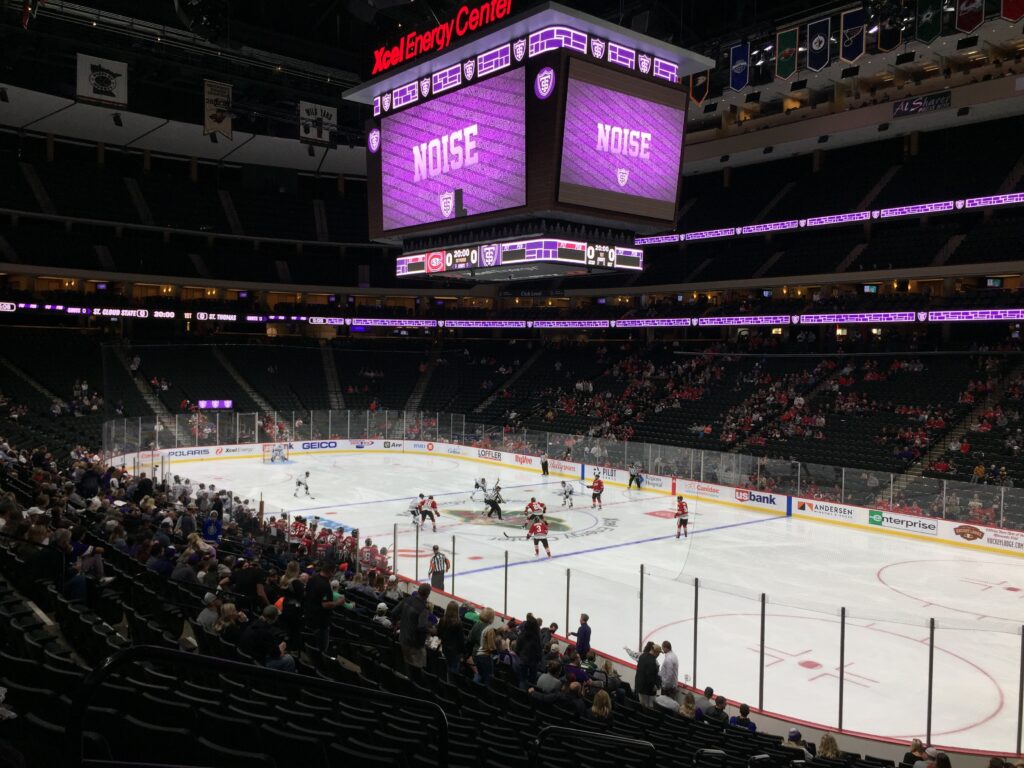
Teams: St. Cloud State Huskies at St. Thomas Tommies

Where: Xcel Energy Center in St. Paul, Minnesota

When: October 3, 2021 at 5:07 p.m.

Puck drop at the first St. Thomas home game on October 3, 2021
Opening puck drop at the first St. Thomas home game on October 3, 2021.

This was the second game of a home-and-home series to begin the 2021-22 season for these two teams. St. Cloud State hosted the first game on Saturday night and showed the new Division I team why they are ranked #2/3 in the preseason polls. The Huskies impressively won 12-2. The same two teams met on Sunday evening on October 3, 2021, in St. Paul. It’s credited as the first Division I home game for St. Thomas despite it being at the Xcel Energy Center instead of the team’s St. Thomas Ice Arena. 4,261 fans were in attendance.

St. Cloud State jumped out to a 1-0 lead on a power play goal from Zach Okabe in the first period. Jami Krannila and Spencer Meier assisted on the play. Shots on goal in the first period were 12-4 in favor of the Huskies.

St. Cloud State celebrates a first period goal to put the Huskies up 1-0
St. Cloud State celebrates a first period goal to put the Huskies up 1-0.

The Xcel Energy Center is home to the NCHC Frozen Faceoff. This weekend of hockey played every March includes the final four teams left in the conference tournament with the winner of the title game hoisting the Frozen Faceoff trophy and earning an automatic bid to the national tournament. The NCHC conference tournament took place in Grand Forks, North Dakota in 2021 but the Frozen Faceoff will return to St. Paul in 2022. This game against St. Thomas is the first time St. Cloud State has played at the Xcel Energy Center since March 23, 2019, when the Huskies lost 3-2 in 2OT to UMD in the 2019 NCHC Frozen Faceoff title game.

NCHC team logos showing that the Xcel Energy Center is home of the NCHC Frozen Faceoff
The Xcel Energy Center is home to the NCHC Frozen Faceoff.

In the second period, the Huskies scored again to make it 2-0 heading into the third period. This time the goal was from Micah Miller with the assist from Kevin Fitzgerald. The Tommies had several chances but came up short. Shots in the second frame were 7-6 in favor of St. Cloud State.

St. Thomas gets a shot off in the second period of the October 3, 2021 game
St. Thomas gets a shot off in the second period of the October 3, 2021 game against St. Cloud State.

There’s an area in the Xcel Energy Center that is devoted to the Hobey Baker and Patty Kazmaier Memorial Awards. It includes a list of past winners, replica Hobey Baker Award, and jerseys of a handful of past recipients. There are also summaries of the awards and what they mean to the hockey community.

There was no scoring in the third period. St. Thomas pulled the goalie but no goals were scored for either team before time expired. St. Cloud State outshot the Tommies 29-14. David Hrenak recorded his first shutout of the season as the Huskies opened the season with two wins. The Tommies put up a good fight but are still looking for the program’s first Division I win.

St. Cloud State still pushing the puck in the final minutes of the St. Cloud State and St. Thomas game on October 3, 2021
Final minutes of the St. Cloud State and St. Thomas game on October 3, 2021.

CHH Featured Flashback Header

The St. Thomas Tommies will begin a new chapter this Saturday, October 2. When the puck drops in St. Cloud against the Huskies, St. Thomas will have officially made the jump to Division I. The Tommies will be the second team in as many years to join the ranks of the top men’s division of college hockey. But unlike Long Island, who created a program from scratch prior to the 2020-21 season, St. Thomas has a long and storied history of hockey. This is a program that began play in 1920. Prior to this season, the Tommies had only been a part of one conference: Minnesota Intercollegiate Athletic Conference (MIAC). With a new division comes new scenery. The Tommies will immediately participate in the revamped CCHA. However, the team must first play the national runner-up and NCHC powerhouse, St. Cloud State to begin the season. The home-and-home series will occur on Saturday and Sunday with the Tommies first home game taking place at the Xcel Energy Center; home of the Minnesota Wild.

In the featured photo, the St. Thomas hockey team is shown participating in an intrasquad scrimmage in 1924. The location is presumably on campus. The Tommies went 8-2 during the 1923-24 season. The program holds the record for most wins among all Division III hockey schools. As the sixth Division I hockey program in Minnesota, the program will have its hands full on the ice in the CCHA as well as the recruitment trail. But if past accomplishments are any indication and early trends continue for this new-look program, Rico Blasi’s team will not only fit right in, it will excel within the State of Hockey.

Photo Credit: Minnesota Historical Society.